
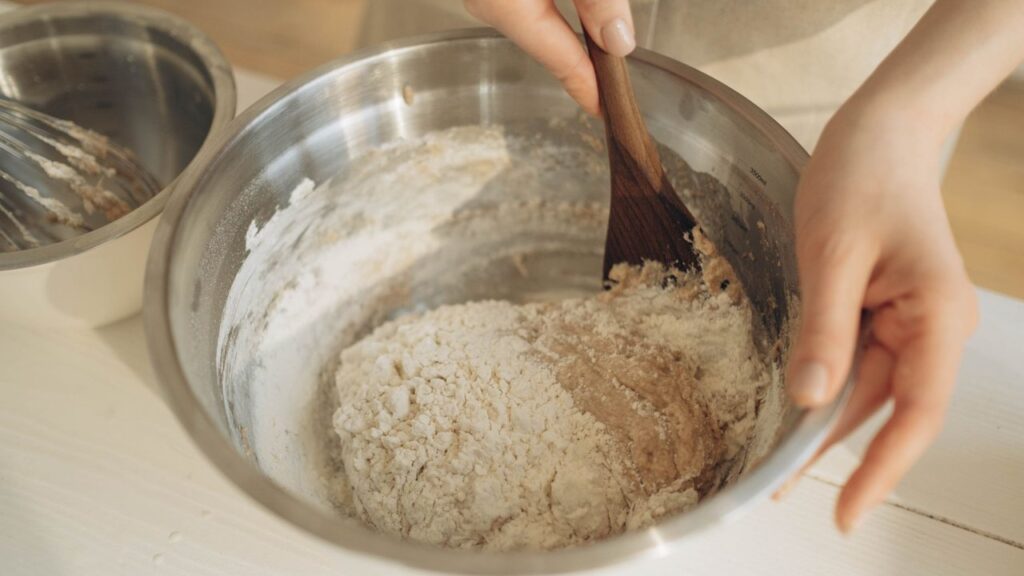
Most families know not to let kids lick the spoon because of raw eggs, but the flour sitting in that same bowl carries its own risk. According to the Centers for Disease Control and Prevention, flour is almost always a raw, untreated ingredient — grinding wheat into powder does nothing to kill the germs that can contaminate it in the field or during milling, so flour can carry E. coli and Salmonella straight from the bag into your mixing bowl (CDC). That means the cookie dough, cake batter, pie crust or holiday ornament dough your family handles this season isn’t safe to taste until it’s actually baked.
Kansas State University food scientist Karen Blakeslee, who studies food safety at K-State Extension, says the gap in public awareness is real. Consumers have generally absorbed the warning about raw eggs, but far fewer recognize that flour itself is the uncooked ingredient doing the damage. “Consumers may learn the hard way about eating raw flour or raw eggs, and they get foodborne illness,” she said, noting that flour is a raw food from the moment it’s milled and “has always been that way” (K-State Extension).
Why Flour Carries E. coli and Salmonella Risk
Grain can pick up harmful bacteria at several points between the farm and the package — in the field, during harvest, or while it’s being milled and processed. Bleaching and grinding don’t sterilize it. The CDC has investigated multiple outbreaks tied to raw flour or cake mix over the years, including cases in 2016, 2019, 2021 and 2023, some of which led to product recalls (CDC). Because flour has such a long shelf life, it’s worth checking your pantry against current recall notices before this year’s baking marathon, something the CDC specifically recommends through FDA’s recall listings.
A 2021 survey from the National Center for Biotechnology Information, similar to a 2019 U.S. Food and Drug Administration survey, found that while 85% of people surveyed were aware flour recalls or outbreaks happen, only 17% believed a recall or outbreak would actually affect them personally (K-State Extension). That gap between knowing the risk exists and believing it applies to your own kitchen is exactly why raw flour keeps causing illness during a season when so many households are mixing batter by hand.
Why Microwaving or Baking Flour First Doesn’t Fix It
Some home bakers have tried heat-treating flour themselves — microwaving it or toasting it in the oven before using it in a no-bake recipe — hoping to kill off any bacteria in advance. Colorado State University Extension points out that university research has shown this kind of home pretreatment isn’t reliably effective at reducing bacterial risk, and it introduces its own hazards, including fire and dust-explosion risk when flour is heated in certain ways (CSU Extension). Commercial manufacturers that sell edible cookie dough or cookie-dough ice cream use heat-treated flour and pasteurized eggs produced through processes that aren’t available to home cooks, which is why a store-bought edible dough is safe to eat straight from the package while homemade dough is not.
Reading Labels on Store-Bought Dough
Not every tub of dough on a grocery shelf is meant to be eaten raw. The CDC advises checking the label carefully before assuming a product is safe without baking — some packaged cookie dough and brownie batter is specifically formulated and labeled as edible, using pasteurized eggs and treated flour, while other refrigerated dough is still meant for the oven only. If a package doesn’t explicitly say it’s safe to eat raw, treat it the same way you’d treat homemade dough: bake it first. Raw Flour and Dough | Food Safety | CDC
Keeping Kids and Pets Away From the Bowl During Holiday Baking
Holiday baking is often a group activity, which raises the stakes. Children under five, older adults and anyone with a compromised immune system face the highest risk of serious illness from foodborne bacteria, according to both CDC and CSU Extension guidance. Blakeslee specifically cautions against letting kids use raw dough as play clay for holiday crafts like dough ornaments — even if a child doesn’t eat it, touching it and then putting hands near the mouth is enough to pose a risk, so any hands-on dough play should be supervised with a handwashing follow-up (K-State Extension). CSU Extension’s practical suggestion for a busy kitchen: give gentle reminders not to taste the dough at the start and throughout the baking session, and if little helpers truly can’t resist the urge, shift their job to decorating and packaging once everything has already come out of the oven (CSU Extension). Pets deserve the same caution — don’t let them lick bowls or lap up spills from batter containing raw flour or eggs.
The Cleanup Step Most Kitchens Skip
Because flour is a fine powder, it spreads further than most cooks expect — dusting countertops, utensils and hands well beyond the mixing bowl itself. The CDC recommends washing hands with soap and water after handling flour, raw eggs or raw dough, and washing bowls, utensils and countertops with hot, soapy water afterward, specifically to keep that contamination from transferring to ready-to-eat foods sitting nearby on the same counter. It’s a small habit, but it closes the gap between the flour you just measured and the finished plate of cookies someone is about to pass around. Raw Flour and Dough | Food Safety | CDC
The actual fix for all of this is simple, even if it’s less fun than a spoonful of raw dough: bake or cook the full recipe according to the directions before anyone tastes it, and treat flour with the same seriousness you already give raw eggs. If your family’s holiday tradition includes a taste test before the tray goes in the oven, this is the year to move that tradition to after the timer goes off.
Image Credit: Ron Lach — Pexels License / Pexels