
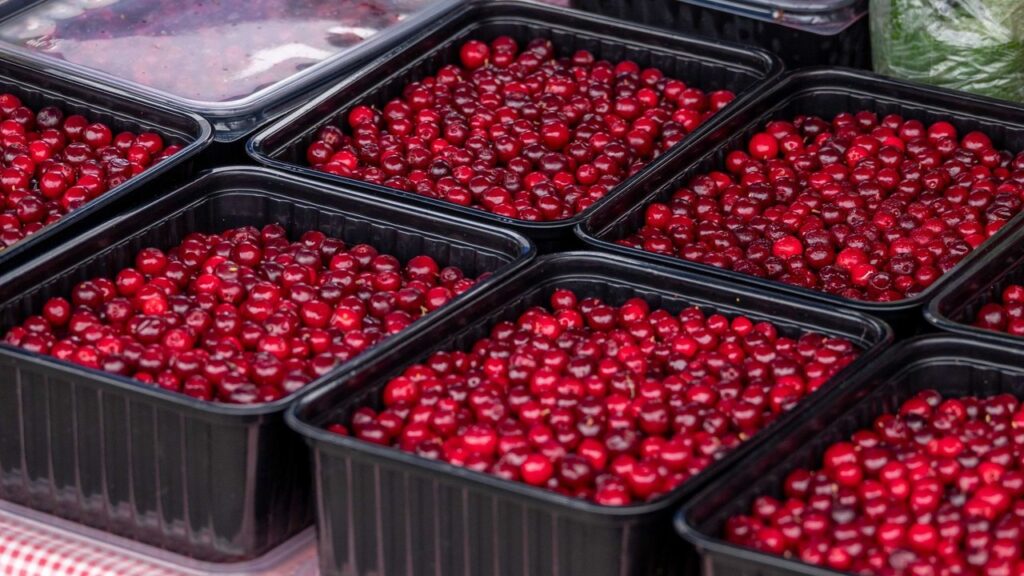
That old trick of dropping a cranberry on the counter to see if it bounces isn’t a kitchen myth passed down for fun—it’s rooted in something real about how the fruit is built. A firm, fresh cranberry has a tiny cluster of internal air pockets that give it spring, while a softening or spoiling one loses that structure and just thuds. But the bounce test, useful as it is, only tells you about firmness. It can’t tell you whether the berry tastes good, whether it’s been treated with anything, or whether trouble is hiding where your eyes and fingers can’t reach.
Why a cranberry bounces at all:
Cranberries are one of the few fruits that float, and the reason is the same reason they bounce. Inside each berry are small hollow air chambers. That trapped air gives a firm cranberry buoyancy in water and spring on a hard surface. It’s also why commercial growers can harvest cranberries by flooding the bog and skimming the floating fruit off the top. When a cranberry is fresh and firm, those internal chambers are intact and the skin holds its tension, so the berry rebounds instead of just flattening out.
What a good bounce actually confirms:
A lively bounce is a reasonably reliable sign that the berry is firm, that its internal structure hasn’t collapsed, and that it probably isn’t mushy, bruised through the middle, or starting to break down from rot. Softness is one of the clearest signs that a cranberry is past its prime, since the fruit loses that internal air structure as it deteriorates. So if you toss a handful on a cutting board and most of them hop, you’re at least getting real information about texture and general condition, not just folklore.
What the bounce can’t tell you:
A firm bounce says nothing about sweetness or tartness, since that comes down to ripeness and variety, not structural integrity. It also can’t tell you about mold that’s developing from the inside, which sometimes shows up before the skin softens enough to change how the berry bounces. A cranberry can look and bounce fine on one side while having a soft, discolored spot you simply didn’t see from that angle. The test tells you nothing about pesticide residue, how the fruit was washed, or how long it sat at an unrefrigerated temperature before the firmness test would ever register a difference. In other words, bounce measures one physical property—internal firmness—not the full picture of quality or safety.
Using the test without over-relying on it:
If you’re buying loose cranberries, do a quick visual scan first. Fresh ones are typically a deep, even red to reddish-purple, firm to light finger pressure, and free of obvious wrinkles or soft, sunken patches. Pick up a handful and give it a light bounce test on a stable surface, not as the only check but as a confirmation of what your eyes and fingers already suggested. A cranberry that looks dull, feels soft, or has a shriveled patch isn’t worth bouncing—it has already told you what you need to know.
When the berries are already bagged:
Most cranberries at the store come in sealed plastic bags, which makes the literal bounce test impractical unless you want to shake the whole bag and watch for movement, which does still work as a rough version of the same idea. Firm berries will shift and tumble loosely; soft or clumped berries tend to stick together or sit heavily in one spot. Look through the bag for any berries that appear shriveled, dull, or noticeably lighter in color than the rest. Check the bottom of the bag for pooled juice or a wet, reddish stain, which usually means at least a few berries inside have already started breaking down. A bag with visible moisture or mush at the bottom is worth skipping even if the top layer looks fine.
Judging the batch, not just one berry:
One soft cranberry in a bag of two hundred doesn’t mean the whole bag is bad, and one perfect bouncer doesn’t guarantee every berry underneath it is equally firm. The test is most useful as a batch check—bounce or shake a representative sample rather than judging quality from a single berry pulled off the top. If a clear majority bounce well, look evenly colored, and feel firm, the bag is probably fine even if you spot the occasional outlier.
The real value of the bounce test is that it gives you a fast, hands-on way to confirm firmness before you commit a whole bag to your cart or your recipe, not a guarantee that covers everything the fruit can’t show you at a glance. Pair it with a look at color, a check for shriveling, and a glance at the bottom of the bag for moisture, and you’ll catch far more problems than the bounce alone would ever reveal. Treat a good bounce as one useful piece of evidence, not the whole verdict on what’s inside the bag.
Image Credit: Sergei Starostin — Pexels License / Pexels