
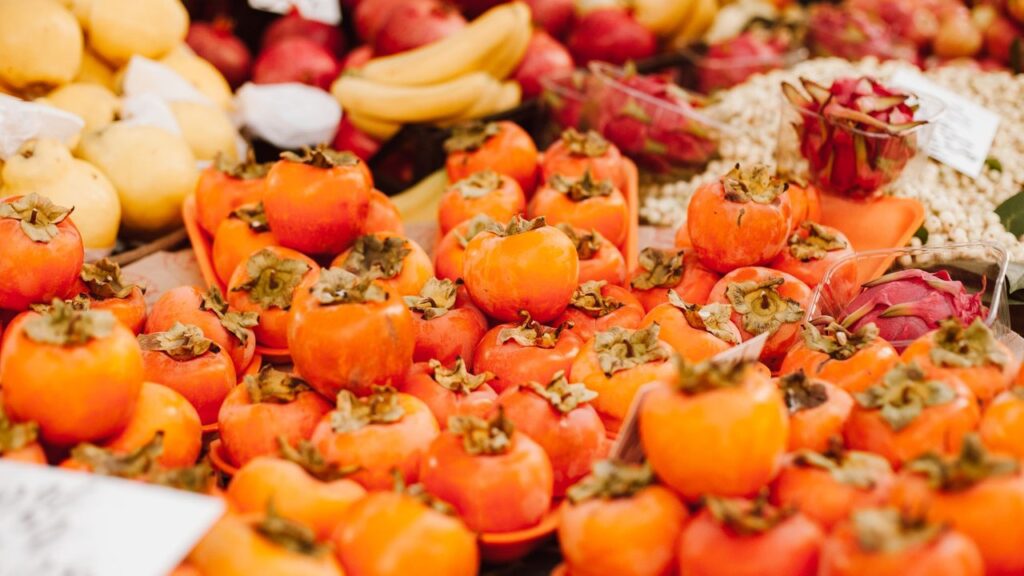
The difference between a persimmon that tastes like honeyed custard and one that turns your mouth into a cotton ball comes down to two things: which variety you picked up, and whether it was actually ready to eat. Shoppers who grab the wrong type at the wrong stage often swear off persimmons entirely, when the fruit itself was never the problem. Knowing which kind is in your hand, and what ripe actually looks like for that kind, changes the whole experience.
The two persimmons hiding under one name
The two persimmons hiding under one name
Most grocery stores carry two main types, and they behave nothing alike. Fuyu persimmons are squat and flattened, shaped something like a small orange tomato. They belong to the non-astringent group, meaning they can be eaten while still firm, sliced like an apple into a salad or eaten out of hand with a satisfying crunch. Hachiya persimmons look very different: elongated, almost acorn-shaped, tapering to a point. These are astringent persimmons, and that single word is the one shoppers most need to understand before buying.
Why an unripe Hachiya can ruin a bite
Astringent varieties like Hachiya are loaded with soluble tannins while they are firm. Bite into one too early and those tannins bind to proteins in your saliva, producing an intensely dry, puckering sensation that lingers far longer than it should. It is not spoiled or unsafe in that unripe state, it simply has not undergone the chemical change that turns those soluble tannins insoluble, which is what finally mellows the flavor into something sweet and almost jammy. A firm Hachiya and a soft, slightly wobbly Hachiya are, flavor-wise, nearly different fruits.
Reading ripeness before you buy or bite
For a Fuyu, look for consistently deep orange-red color and skin that is taut but gives slightly, similar to judging a ripe tomato. It can be eaten firm, though many people find the flavor sweeter and less tannic once it softens a bit further. For a Hachiya, firmness is the warning sign, not reassurance. It needs to feel genuinely soft all the way through, with skin that looks almost translucent and flesh that yields like a ripe plum or an overripe tomato, before it is pleasant to eat. If it still feels dense or only gives a little at the stem end, it needs more time. Color alone is not a reliable shortcut for Hachiya, since it can turn fully orange well before the tannins have mellowed.
Speeding up ripening at home
Both types will continue to ripen after purchase if left at room temperature out of direct sun, away from the refrigerator, which slows the process considerably. Placing a Hachiya in a paper bag with an apple or banana traps the ethylene gas those fruits release, which can shorten the wait from a week or more down to several days. Freezing a Hachiya and then thawing it is a long-used home trick for breaking down texture and reducing perceived astringency faster, which works well if you plan to use the pulp in baking rather than eating it fresh off the counter. There is no reliable shortcut that makes an underripe Hachiya taste good immediately, so patience genuinely matters more with this variety than with almost any other common fruit.
Ways to use each type once it’s ready
A firm Fuyu earns its keep sliced thin over greens with a sharp vinaigrette, where its mild sweetness and crunch play against bitter leaves or salty cheese. A softer Fuyu works well diced into a grain bowl or simply eaten out of hand like an apple. A fully ripe Hachiya, by contrast, is better treated almost like a sauce than a snack: scoop the custardy pulp into a bowl and swirl it into yogurt or oatmeal, fold it into quick bread or muffin batter in place of mashed banana, or spoon it over something simple like plain cake. Because the texture at that stage is so soft, Hachiya rarely holds up to slicing or salads the way Fuyu does.
Shoppers who remember one rule tend to avoid the worst surprises: treat a Fuyu like an apple and a Hachiya like an avocado that has to fully give before it is good. Check the shape first to know which category you are dealing with, then judge firmness against that category rather than against persimmons in general. A little patience with the pointed, astringent kind is really the whole secret, since the sweetness was there all along, just waiting for the fruit to finish its own work.
Image Credit: ROMAN ODINTSOV — Pexels License / Pexels