
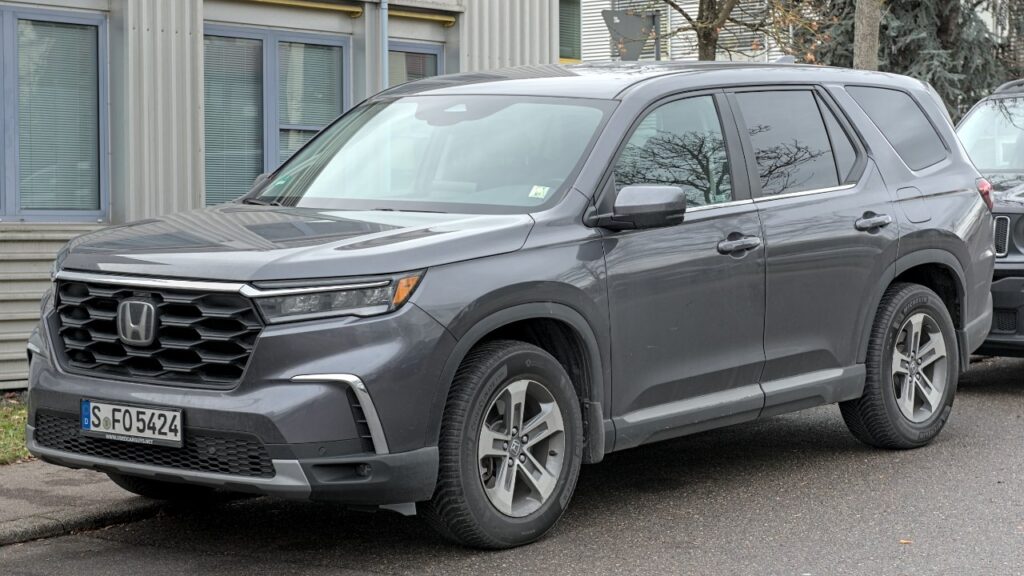
You’re mid-turn in a parking lot, or easing around a curve on the highway, and the wheel suddenly gets heavy — like the power steering just quit. For more than 635,000 Honda and Acura owners, that’s not a hypothetical. It’s the exact failure the company just issued a recall over, and it’s already hurt one driver.
Which vehicles are affected
Honda is recalling 635,808 vehicles across three models, according to the recall report filed with the National Highway Traffic Safety Administration (NHTSA campaign number 26V721000) and reported by KTVU FOX 2: 2023–2025 Honda Pilot (383,110 units), 2022–2024 Acura MDX (177,100 units) and 2021–2025 Acura TLX (75,598 units). If you drive one of those three, in roughly those model years, this recall is about your car specifically — not a general “some Hondas” warning.
Honda and Acura share engineering across both brands, which is why a steering software issue on a Pilot can show up, nearly identically, on an MDX or a TLX. The fix will eventually be the same across all three.
What’s actually wrong
The short version: an improper software configuration in the electronic power steering system can push it into what’s called a failsafe mode. Once that happens, power assist shuts off and the wheel gets noticeably harder to turn — enough, per the recall report, to raise real crash risk, especially at low speed or mid-maneuver, when a driver least expects the wheel to fight back.
This isn’t a mechanical steering failure where you lose control of the car entirely. The steering still works. It just stops helping — which sounds minor until you’re the one trying to muscle a two-ton SUV through a turn you’d normally make without thinking about it.
One injury, and how Honda found the pattern
Honda has received 146 warranty claims tied to the issue and is aware of one reported injury connected to it, per the NHTSA filing. No deaths have been reported. According to KTVU’s reporting on the filing, Honda says it first learned of the problem in November 2021, but couldn’t pin down the cause for years because error codes from early reports had already been deleted by the time engineers could examine them. The company says it finally replicated the failure in December 2025 and kept analyzing it until this past October, when it decided a recall was warranted.
That gap — years between the first reports and the actual recall — isn’t unusual for a hard-to-reproduce software issue, but it’s worth knowing if you’ve noticed your steering feel oddly heavy even once in the last year or two. It may not have been your imagination.
What Honda is doing about it
The remedy is a software fix, not a part replacement: authorized Honda and Acura dealers will reprogram the electric power steering control unit, free of charge, once your vehicle’s notification arrives. There’s no new hardware involved — this is entirely a case of correcting how the existing system responds to a calculation error, rather than swapping out a failed component.
Owner notification letters are expected to go out starting December 14, 2026. If your VIN is among the affected population, it should already be searchable in NHTSA’s recall database as of mid-November.
What to do before your letter arrives
You don’t have to wait for the mail to find out if your specific car is affected. Look up your VIN — the 17-character number on your windshield’s lower-left corner or on your registration card — through NHTSA’s recall lookup tool, which will tell you directly whether an open recall applies to that exact vehicle, not just the model in general.
If it comes back affected, you can call your local Honda or Acura dealer and ask to be put on the list for the software update rather than waiting for the letter to show up in the mail first. The fix itself is quick once it’s scheduled — it’s a reprogram, not a multi-day repair.
What to watch for in the meantime
If your power steering has ever felt like it suddenly got heavier for no reason — even briefly, even if it seemed to correct itself — that’s worth mentioning to your dealer when you bring the car in, recall or not. A failsafe event that resolves on its own can still be the same underlying issue showing up intermittently before it becomes a consistent problem.
In the meantime, driving the vehicle isn’t prohibited — Honda hasn’t told owners to park these cars, the way some more severe recalls do. It’s a “get it fixed on the normal recall timeline” situation, not a “stop driving it today” one. Still, knowing the wheel could suddenly demand more muscle than usual is the kind of thing worth being mentally ready for, especially if you’re usually the one driving the kids to practice.
If you try one thing this week
Check your VIN against NHTSA’s database, even if you haven’t gotten a letter yet. It takes a couple of minutes, it tells you definitively whether your specific car is on the list, and it means you’re not relying on the mail to find out something this concrete about a vehicle you drive every day.