
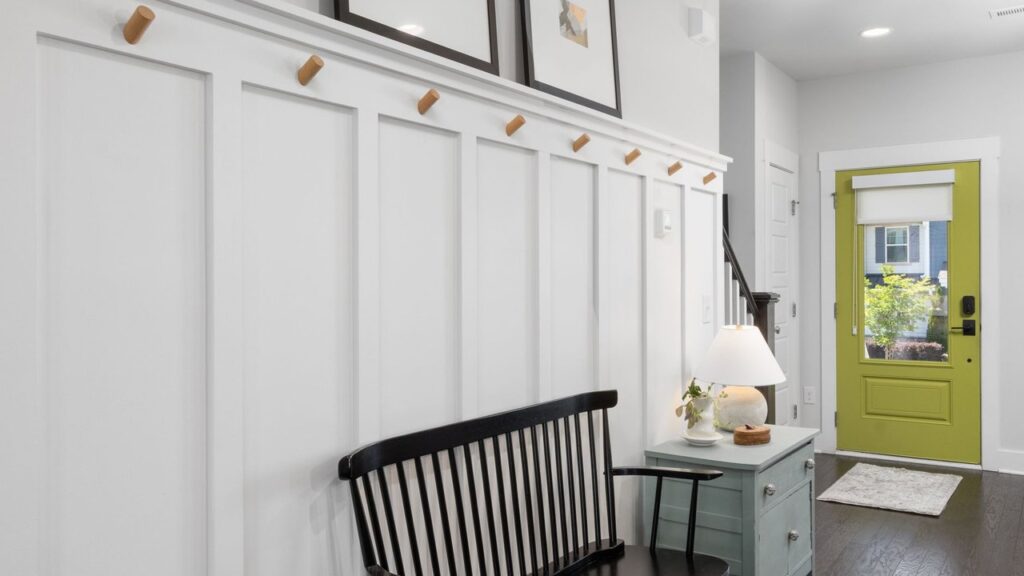
A bench can look perfect in a showroom and still make your mornings worse the moment you bring it home. The real test isn’t how it photographs against your entry wall — it’s whether the seat actually sits at a height that lets you put on shoes, set down bags, and get back up without a daily negotiation with your own knees. Seat height is the quiet variable that decides whether a bench becomes a genuinely useful landing spot or an attractive obstacle you learn to avoid.
Why the number on the tag matters more than the finish.
Most seating designed for everyday sitting — dining chairs, benches, ottomans meant to be sat on rather than just displayed — tends to land somewhere around 17 to 19 inches from the floor to the top of the seat. That range isn’t arbitrary; it roughly matches the leg length of an average seated adult, letting knees bend near a right angle instead of folding up sharply or dangling. Decorative entryway benches often break from that range on purpose. A low bench, sometimes 14 to 16 inches, can look sleeker and more proportioned under a mirror or coat hooks, but it was designed primarily to be looked at, not sat on for the thirty seconds it takes to tie a sneaker.
What a too-low seat actually costs you.
Picture a bench that sits closer to a footstool than a chair. Bending down to reach it, then pushing back up from it, asks more of your knees and lower back than a standard-height seat does — not because anything is damaged, but because the mechanics of rising from a low surface simply require more leverage. For someone managing a toddler, a heavy bag, or a bad knee day, that extra effort adds up fast, and it tends to show up as the bench becoming the thing you step around rather than the thing you use.
What a too-high seat costs you instead.
The opposite problem is just as common and less talked about. A bench pulled from a taller decorative line, sometimes pushing 20 inches or more, can leave shorter adults and children with their feet dangling rather than planted. A seat your feet can’t rest flat on isn’t stable to lace a boot from, and it shifts weight backward in a way that makes the whole bench feel tippier than it should, especially on a narrow or lightweight frame.
The household the bench actually has to serve.
An entryway bench rarely has one user. Picture a hypothetical household with two adults, a ten-year-old, and a visiting grandparent — four different leg lengths and four different ideas of comfortable. A seat height near the middle of the standard 17 to 19 inch range tends to work reasonably well across that spread, while a bench chosen purely because it matched a specific decorative moment might only suit whoever happened to be in mind when it was picked. If the bench’s main job is shoe-changing, a touch lower than standard can still work, since feet are already meant to be moving during that task. If its main job is resting, waiting, or setting down a child to put on a coat, standard chair height serves nearly everyone better.
Measuring before the bench ever enters the house.
The fix is almost embarrassingly simple and almost always skipped. Before buying, measure the seat height on the listing or tag, then compare it to a chair already in the home that feels comfortable to sit in and rise from. If the numbers are close, the bench will likely behave the way that chair does. If the new bench is several inches shorter or taller, assume the feel will be noticeably different, not just the look. When buying in person, actually sit down, lace an imaginary shoe, and stand back up before deciding. A showroom bench surrounded by matching décor is staged to be admired, not to be tested the way it will be used at seven in the morning with one child missing a shoe.
When the beautiful option and the functional one genuinely conflict.
Sometimes the bench that fits the entryway’s proportions best really is outside the standard comfortable range, and that’s a real tradeoff worth naming rather than ignoring. A narrow hallway might only have room for a low, slim profile bench; a grand foyer might call for something taller to match scale. In those cases, treat the bench as doing one job well rather than every job adequately — a low bench for setting bags and a nearby wall hook for coats, or a taller bench paired with a step stool for a child, rather than expecting one piece of furniture at the wrong height to quietly absorb every use.
Appearance gets a bench through the front door; dimensions decide whether it earns its place. The next time a bench catches your eye, let the seat height be the second thing you check, right after the color — because the one that fits how your body actually sits down and stands up will still be in daily use long after the one chosen for looks alone has become a place to pile mail instead.
Image Credit: Curtis Adams — Pexels License / Pexels