
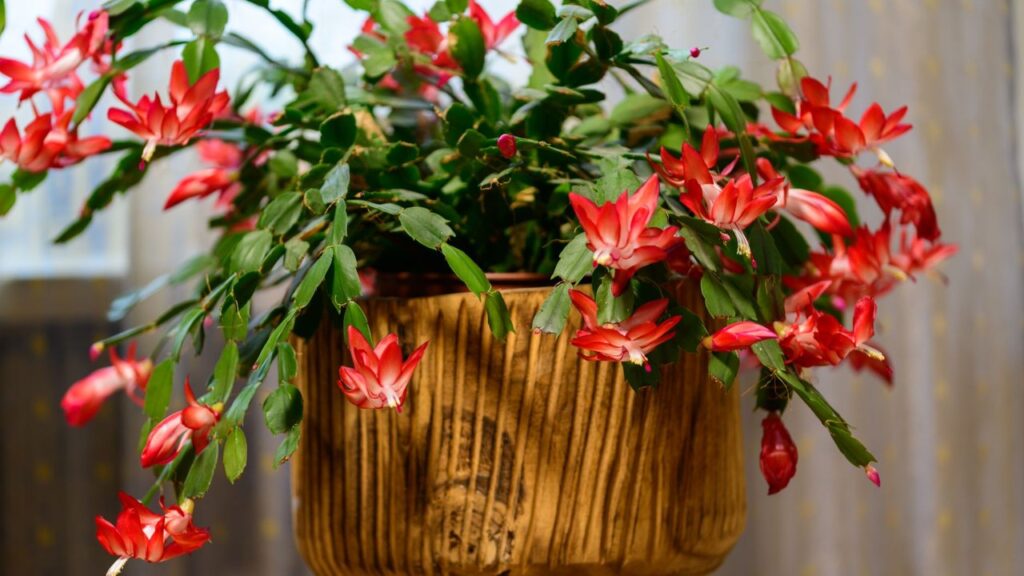
If your Christmas cactus has thick, glossy, perfectly healthy-looking segments but never produces a single bud, the plant almost certainly isn’t sick or underfed. It’s simply not getting the environmental cues it needs to switch from growing leaves to growing flowers. For this plant, that cue has far less to do with fertilizer than with how much uninterrupted darkness and how much cool air it experiences in the weeks before bloom time.
Christmas cactus, along with its close relatives Thanksgiving cactus and Easter cactus, is what’s known as a short-day plant, though the more accurate description is a long-night plant. In its natural habitat, flowering is triggered when nights become long enough and temperatures drop enough that the plant senses the season shifting. Indoors, especially in a modern home full of lamps, overhead lights, televisions and hallway fixtures, that signal frequently never arrives. A plant sitting in a living room that gets evening light every night of the week can grow lush and green indefinitely without ever feeling the “go ahead and bloom” trigger.
Why nights matter more than any plant food
Fertilizer supplies nutrients for vegetative growth: stems, leaf segments, root development. It does not supply the dormancy-like signal that tells the plant it’s time to form flower buds. A Christmas cactus fed regularly but kept in a brightly lit room year-round can end up with exactly the frustrating combination described in the headline — strong, healthy green growth and no flowers at all. If anything, heavy nitrogen fertilizing late in the season can push the plant further toward leaf production right when you want it conserving energy for buds instead.
This doesn’t mean fertilizer is bad for the plant. During its active growing months in spring and summer, a balanced houseplant fertilizer supports healthy segments and root growth. The issue is timing and emphasis: most growers fertilize through the warm months and then taper off by early fall, shifting the plant’s attention toward the darkness-and-temperature cues that actually start the blooming process.
Getting the darkness right without turning it into a chore
The general guideline many growers use is roughly twelve to fourteen hours of uninterrupted darkness each night for several consecutive weeks, usually starting in early-to-mid fall for blooms around the winter holidays. “Uninterrupted” is the operative word. Even a hallway light flicking on for a few minutes, a phone screen glowing nearby, or a streetlamp shining through a thin curtain can be enough to disrupt the signal for some plants, because they’re sensitive to light during that dark window.
In practice, this is easier to manage than it sounds. A spare closet, an unused room, or simply covering the plant with a box or opaque cloth each evening and uncovering it in the morning can recreate the long, dark nights the plant is looking for. The key is consistency over several weeks, not a single dramatic gesture. Skipping a night here and there won’t necessarily ruin the process, but a consistently interrupted schedule will likely delay or prevent budding.
Where cooler temperatures fit into the pattern
Darkness alone often works, but pairing it with cooler nighttime temperatures tends to make the trigger more reliable. Christmas cactus generally sets buds well when nights fall into a cooler range, roughly the mid-50s to mid-60s Fahrenheit, rather than staying at typical room temperature all night. This is one reason plants that spend early fall on a porch, in a three-season room, or near a drafty window sometimes bud up with no special effort at all — they’re naturally experiencing both the longer nights and the cooler air without anyone managing it on purpose.
If your home stays uniformly warm day and night, you can sometimes compensate by relocating the plant somewhere a few degrees cooler in the evenings, as long as it isn’t exposed to freezing temperatures or harsh drafts, both of which can damage the foliage rather than help it.
What fertilizer actually does — and when it backfires
It helps to think of fertilizer as supporting the structure the plant already has, not as a switch that turns on flowering. A Christmas cactus that’s been fed generously all summer has probably built strong, healthy segments — which is good, because that’s the framework buds will eventually form on. But continuing heavy feeding into fall, right when the plant should be shifting toward dormancy-like conditions, can work against you by keeping the plant in active-growth mode instead of bud-setting mode. Many growers simply stop fertilizing around early fall and don’t resume until after flowering has finished and new growth starts again in spring.
Once buds appear, the rules change again
After you finally see small buds forming along the segment tips, the priority shifts from encouraging flowering to protecting it. Sudden temperature swings, cold drafts from a door, or moving the plant to a new location can cause those buds to drop before they open. It’s worth keeping the plant in a stable spot, with consistent light and temperature, from the moment buds appear until they bloom.
If your plant has skipped flowering this year, the fix isn’t more plant food. It’s giving it several weeks of genuinely long, dark nights, pairing that with cooler evening temperatures where possible, and holding off on fertilizer until after the show is over.
Image Credit: Sergej ***** — Pexels License / Pexels