
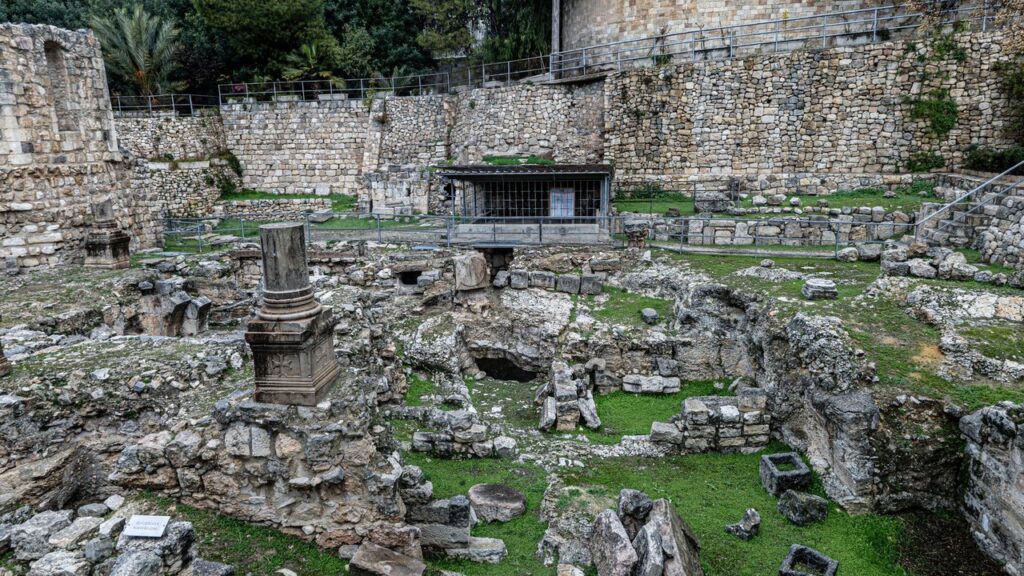
Near a gate in old Jerusalem called the Sheep Gate stood a pool with five covered walkways, and under those walkways lay people who could not walk, could not see, and could not move without help. John’s Gospel tells us that one man among that crowd had been in that condition for thirty-eight years, and that Jesus walked up to him and asked what sounds, at first glance, like the strangest possible question: “Do you want to get well?” That question is worth more attention than it usually gets, because the man’s answer — and Jesus’s response to it — says something true about how people actually relate to the things that have shaped their whole lives.
The account is found in John chapter five, verses one through nine. Jesus has gone up to Jerusalem for a feast, and at the pool he notices one man in particular out of what the text calls a great number of disabled people lying there. John tells us Jesus “learned that he had already been in this condition a long time,” and it is only after noticing that detail that he asks the question. The man answers, “Sir, I have no one to put me into the pool when the water is stirred up; while I am going, another steps down before me.” Jesus tells him, “Get up, take up your bed, and walk,” and the man is healed on the spot.
A detail honest readers should know about the water
Many readers of older translations will remember a line about an angel stirring the water at certain times, giving healing power to whoever stepped in first. That detail appears as verse four in some translations and is bracketed, footnoted, or omitted entirely in most modern ones, because it is absent from the oldest and most reliable Greek manuscripts of John. Most scholars treat it as a later explanatory note that crept into the text to explain a popular belief about the pool, rather than something John originally wrote. This matters for how we read the scene: the man’s answer to Jesus is best understood as describing an ordinary, widely held folk belief about the pool’s waters, not a divinely confirmed mechanism. Nothing about the healing itself depends on that disputed line — Jesus heals the man by his own spoken word, with no reference to water, timing, or an angel at all. Being honest about this textual detail does not weaken the story; it actually sharpens what Jesus does, because it shows the healing had nothing to do with the system the man had spent decades failing to beat.
Why the question is not as obvious as it sounds
On the surface, “do you want to get well” seems like an odd thing to ask someone who has been unable to walk for thirty-eight years. Of course he wants to be healed — who would not? But people who live for decades inside a limitation often develop a complicated relationship with it that goes beyond simple desire. A long-term condition can become the organizing fact of a person’s days: where he lies, who passes by, what he expects from each morning, what he has stopped expecting altogether. After enough years, change itself can feel less like relief and more like an unfamiliar and even frightening prospect, because the old condition — however painful — is at least known territory. Jesus’s question does not doubt the man’s suffering. It tests whether, after thirty-eight years of disappointment, he is still capable of wanting something different, or whether hope itself has quietly worn out.
Read this way, the question becomes less about physical healing specifically and more about a pattern that extends well past this one man at this one pool: the gap between wanting relief from a hard circumstance in the abstract and actually being ready to receive change when it arrives in a form that interrupts the routine built around the problem. That gap is worth noticing in ourselves, in whatever form it takes — a long-standing resentment, a years-old habit, a relationship pattern, a fear that has shaped decisions for so long it feels like identity rather than circumstance.
The man’s answer is not actually a yes
It is easy to skim past this, but the man never says yes. Jesus asks a direct question with an obvious answer, and the man responds with an explanation of why he has not yet succeeded: he has no one to help him into the water, and someone else always gets there first. It is a true complaint — thirty-eight years of disappointment is more than enough to justify discouragement — but it is also, notably, not the word the question called for. He describes an obstacle rather than stating a desire.
This is a recognizably human move, not a condemnation of the man. People who have been stuck somewhere for a long time often answer “do you want this to change” with a list of reasons it hasn’t changed yet, because the list has become true and familiar in a way that plain hope no longer feels safe to voice. There is nothing shameful in that response; it is simply what prolonged disappointment tends to produce. What is worth noticing is that Jesus does not argue with the explanation, correct it, or demand the yes he technically asked for. He moves straight to the command: get up, take your mat, and walk. The healing does not wait for the man to produce a tidier answer. It responds to him exactly where he is, excuse and all.
A command that assumes ability before it exists
“Get up” is an unusual thing to say to a man who, by his own account and everyone else’s, cannot get up. The instruction asks for the very thing the man does not yet have the capacity to do, and the text tells us that capacity — and action — arrived together, in the same moment as the command. This is worth sitting with rather than rushing past, because it reframes what obedience looked like for this particular man. He was not asked to assess whether he felt strong enough first. He was simply told to act, and the ability showed up inside the acting rather than before it.
That detail is specific to this miracle story, told about this man, in this Gospel — it is not a general formula for every hardship, and nothing here promises that any reader’s circumstance will resolve the way this one did. But the shape of the exchange is still instructive: Jesus’s instruction did not wait for the man to first solve his access problem, recruit a helper, or beat the crowd to the water. The years of trying and failing by the old method were simply set aside by a different kind of intervention entirely.
Why Jesus asks instead of simply healing him
Jesus could have healed the man without a word, the way he heals others elsewhere in the Gospels with a touch or at a distance. Here, he stops to ask a question first. That choice suggests something about how this particular healing was meant to be received — not as something that happened to a passive object lying by a pool, but as something addressed to a person capable of an answer, however imperfect that answer turned out to be. The question invites participation rather than simply overriding thirty-eight years of helplessness with a unilateral act.
This distinction — between healing that happens to someone and healing that is first addressed to someone as a person with a will — is a theme worth carrying into how this passage gets applied beyond its original moment. Whatever long-standing limitation a reader recognizes in her own life, this story does not promise that naming it or wanting it to change will produce the same kind of immediate, miraculous resolution. It does suggest that honest self-examination — actually asking whether you want something to be different, rather than only listing the reasons it hasn’t changed — is itself worth doing, separate from any guarantee about the outcome.
What thirty-eight years can represent beyond this one story
The specific number matters to the original account as a detail establishing just how long this man’s situation had persisted, underscoring the weight of his circumstance rather than symbolizing something else on its own. But the general shape of his situation — a long-standing limitation, a repeated and reasonable excuse, a question that cuts through both — maps onto plenty of ordinary, non-miraculous situations people carry for years: a conflict left unresolved so long it feels permanent, a habit excused by circumstance for so many seasons that changing it feels almost unthinkable, a fear that has quietly run someone’s decisions since long before she could name it. The value in this passage for someone in one of those situations is not a promise that asking the question produces instant resolution. It is the invitation to notice whether, somewhere along the way, the explanation for why things haven’t changed has quietly replaced the actual desire for them to change — and to ask, honestly, which one is still true.
What happens right after the healing
John does not end the story at the pool: the healed man did not yet know who Jesus was, since Jesus had slipped into the crowd. Later Jesus finds him in the temple and tells him to leave his sin behind, warning that something worse could follow if he does not. That specific pairing belongs to this man and this moment — elsewhere in the same Gospel Jesus explicitly rejects the idea that suffering is always traceable to personal sin, so this warning should not be read as a general rule.
The pool of Bethesda healing is remembered mostly for its drama: a man unable to walk for nearly four decades, suddenly standing and carrying his own mat through the crowd that had stepped over him for years. But the question that precedes the miracle deserves the attention the headline gives it, because it is the part of the story that applies even when no pool, no angel, and no instant cure is in view. Before action, before change, before any of it — there is a question worth answering honestly, on its own terms, rather than answering it with the history of why nothing has worked yet.
Image Credit: Regan Dsouza — Pexels License / Pexels