
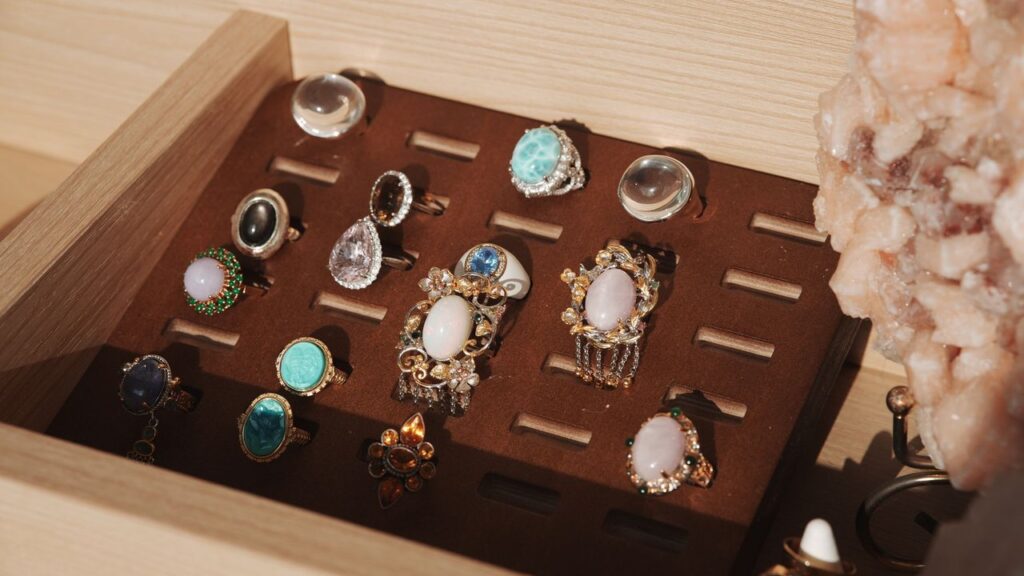
Open any twenty-something’s jewelry drawer these days and you’ll find a strange mix: a chunky gold chain that belonged to a grandmother, a enamel pin picked up for a few dollars at a flea market, a tangle of mismatched rings nobody can quite explain. None of it matches in the traditional sense. All of it tells you something about who she is.
You don’t have to look far to see the shift. Vintage shops that used to feel like dusty afterthoughts are now destinations, and hand-me-down jewelry boxes have become treasure chests instead of forgotten drawers. There’s a reason this particular wave of secondhand accessories feels different from past nostalgia cycles.
Why your mother’s jewelry suddenly feels cool again
When you were younger, that costume necklace in the back of her dresser probably looked dated, even a little embarrassing. Now you reach for it on purpose. Something about wearing a piece that already has a history feels more honest than buying something brand new and anonymous. You’re not just accessorizing an outfit, you’re carrying a small piece of someone else’s life around with you.
There’s also a quieter comfort in it. A piece that survived decades in a drawer has already proven it can last. You trust it in a way you don’t always trust something fresh off a rack, still smelling like plastic packaging.
The appeal of a piece with no clear origin
Vintage stores offer a different kind of pull. You don’t know who wore that brooch before you, and that mystery is part of the charm. You get to invent the story yourself, decide what kind of woman might have clipped it to her coat, and then make it yours entirely.
This is a generation that grew up watching algorithms recommend the exact same ten items to everyone with similar taste. Finding something nobody else owns, something with no influencer attached and no restock date, feels like relief. You’re not trying to look like everyone else’s version of trendy. You’re trying to look like yourself.
Sustainability without the lecture
Nobody wants to be told what to buy, but there’s a quiet logic in choosing something already made rather than something newly produced. You get the satisfaction of participating in less waste without having to turn it into a whole personality or a moral stance. It just happens to feel good, both ethically and aesthetically, and that combination is hard to beat.
Buying secondhand also slows you down in a way fast fashion never did. You have to actually look, dig through bins, try things on, decide if a piece earns a place in your collection. That kind of deliberate searching makes the eventual find feel earned instead of impulsive.
What this means for how you build your own collection
If you’re drawn to this world, you don’t need a plan or a theme. Start with one piece that actually means something to you, whether it comes from a relative’s jewelry box or a bin at your favorite vintage shop. Let the collection grow slowly and unevenly, the way real history does.
Your jewelry doesn’t have to tell a tidy story. It can hold a grandmother’s wedding ring next to a two-dollar pin shaped like a strawberry, and both can matter equally. What makes these pieces appealing isn’t really their age. It’s that they let you wear a version of yourself that feels lived-in, layered, and entirely your own.