
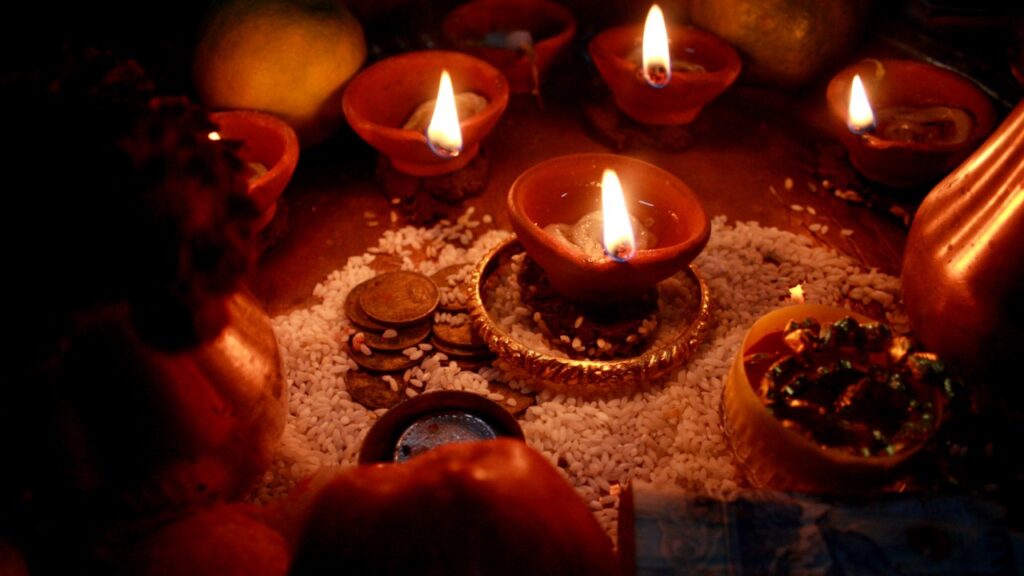
There’s a particular kind of neighbor you notice every fall. The one whose porch suddenly fills with small clay lamps. The one who sends over a plate of sweets you don’t recognize, with a smile that says just try it. You don’t always know the name for what’s happening next door. This October, North Carolina’s governor gave it one, officially, in writing.
Governor Josh Stein proclaimed October as Hindu Heritage Month and set this year’s Diwali date, recognizing a faith community of roughly 4 million Americans. It’s a short document. It changes very little on paper. But it’s worth understanding what it actually says, and what it means for the neighbor whose porch lights up a little earlier than everyone else’s this year.
What the proclamation actually does
On September 25, 2026, Governor Stein signed a proclamation designating October 2026 as Hindu Heritage Month in North Carolina. The same document sets November 8, 2026 as Diwali, the festival most people have at least heard of even if they’ve never attended one.
A gubernatorial proclamation is largely symbolic. It carries no funding, no policy change, no legal requirement. What it does is official. It puts a state’s name behind an acknowledgment that a particular community exists, contributes, and is worth naming on purpose.
That might sound small. For a community that’s often treated as background noise in American civic life, it isn’t.
Why a document like this exists at all
States and cities issue heritage-month proclamations for dozens of communities every year. Most pass unnoticed outside the group being recognized. They exist for a simple reason: public institutions naming who actually lives in their state, out loud, on the record.
North Carolina has roughly 10.8 million residents. A growing share of them are Hindu Americans, many with roots in India, many born and raised right here. A proclamation is one of the few tools a governor’s office has to say, in effect, we see you, without needing a legislature to vote on it first.
It isn’t charity. It isn’t a favor. It’s bookkeeping a state owes to the people actually living in it.
What Diwali actually is, for anyone who’s only heard the name
Diwali, sometimes called Deepavali, means “a row of lights.” The word itself describes the holiday. Small oil lamps, called diyas, line doorways and windowsills for five consecutive nights.
Each night carries its own meaning. The third night, the main event, falls on the new moon and centers on Lakshmi, the deity associated with prosperity and wealth. Families clean their homes beforehand. They draw colorful patterns called rangoli at their front doors. They cook, they visit relatives, they exchange sweets with neighbors who may not share the faith at all.
At its core, the holiday marks light overcoming darkness, and good outlasting evil. That’s not a metaphor reserved for one religion. It’s just stated more literally here, with an actual flame, on an actual doorstep, on an actual date.
The five nights each have their own name and their own small ritual, even if most outside observers only ever notice the third one. Dhanteras opens the stretch with a tradition of buying something metal, often gold or kitchenware, for good fortune. Naraka Chaturdashi follows, then the main night of Lakshmi Puja itself. Govardhan Puja and Bhai Dooj close it out, the latter centered on the bond between siblings rather than wealth or light at all. None of that detail is necessary to understand why a neighbor’s porch looks different in early November — but it’s the difference between recognizing a holiday exists and actually knowing what’s happening inside the house.
The scale behind one state’s proclamation
Hinduism is the world’s third-largest religion, with roughly 1 billion adherents globally, according to the proclamation itself. In the United States, that community numbers around 4 million people.
Four million is larger than the entire population of several U.S. states. It’s not a niche group practicing in isolation. It’s doctors, teachers, small-business owners, and your kid’s classmate’s parents, woven into daily American life in ways that rarely make the news.
North Carolina’s proclamation specifically credits Indian Americans with contributions “in many aspects of our economy, history, and culture.” That’s not flattering filler. It’s an acknowledgment that a community already shapes a state, whether or not the state had gotten around to saying so in writing.
What the governor actually said
“On behalf of the State of North Carolina, it is with immense pride and honor that I recognize the contributions of all Indian Americans who are active in many aspects of our economy, history, and culture,” Governor Stein’s proclamation states.
It’s a formal sentence, written the way proclamations are always written. But read it twice. It’s a public official choosing to name a specific community, specifically, rather than folding it into a vague gesture toward “diversity” that names no one in particular.
That specificity is the entire point of a proclamation like this one.
This isn’t a one-time gesture
North Carolina has made a habit of this. Governor Roy Cooper proclaimed October 2021 as Hindu Heritage Month, citing the same global and national population figures the state still cites today. He did it again in 2022, in 2023, and in 2024.
Governor Stein’s 2026 proclamation isn’t a new idea from a new administration trying to make a first impression. It’s a tradition handed from one governor to the next, regardless of party, repeated often enough that it’s become something close to routine civic business.
Routine is actually the compliment here. A one-time proclamation can read as a gesture. A yearly one reads as a state that has decided this community is simply part of how it does business every autumn.
The White House has done something similar for two decades
North Carolina isn’t inventing this pattern on its own. The White House first marked Diwali in the early 2000s, under a Republican administration, and every president since — of both parties — has continued some version of it, whether through a formal statement, a lit diya, or a reception.
A tradition that’s survived four or five changes of party control in Washington isn’t a partisan talking point. It’s closer to a bipartisan acknowledgment that recognizing a major world religion’s holiday costs a government nothing and signals something real to millions of its own citizens.
That’s the same logic behind North Carolina’s own repeated proclamation, scaled down from the national stage to a single state’s governor’s office.
Why this counts as faith news, not a devotional thought
It would be easy to write about Diwali as a feeling: warmth, light, family, gratitude. All of that is real. None of it is what actually happened this week.
What happened is a state government made a dated, documented decision. An elected official signed something. A specific date got set for a specific holiday, in an official record anyone can look up. That’s news, not sentiment, even though the subject underneath it is sentiment all the way down.
The distinction matters more than it sounds like it should. A feeling about faith doesn’t tell you anything happened in the world this week. A proclamation does.
North Carolina’s proclamation is a small piece of a bigger shift
A proclamation is largely symbolic. A few hundred miles and one law away, something more concrete just happened. Governor Gavin Newsom signed a bill officially recognizing Diwali as a state holiday in California, which became law on January 1, 2026.
The practical effect is real: public schools and community colleges in California may now close for Diwali, state employees can take the day off with pay, and students who celebrate are entitled to an excused absence if their own school stays open. California’s first observance under the new law lands on November 9, 2026 — one day after the date North Carolina’s proclamation sets this year.
School districts in Pennsylvania and Connecticut have separately added Diwali to their own calendars as an official day off in recent years, after parents and students asked their boards to do it. None of that happened in North Carolina this year. But a symbolic proclamation in one state and a paid day off in another are two points on the same line — a steady, multi-year move toward treating a major world religion’s biggest holiday the way Christmas or Hanukkah already get treated on most American calendars.
The neighbor with the early lights, from the other side of the fence
If you’ve never celebrated Diwali, you’ve probably still seen it. The strings of small lights that go up earlier than anyone else’s holiday decorations. The dish of unfamiliar sweets left on a doorstep with no card attached, just a smile at pickup day.
It’s easy to let that stay a mystery you nod politely at every year. It’s also a short conversation away from not being one. Most people celebrating a holiday love being asked about it, as long as the question comes from real curiosity instead of a quiz.
You don’t need to understand every ritual to be a decent neighbor during someone else’s holiday. You just need to notice it’s happening, and say so.
The quiet work actual interfaith friendship takes
Nobody becomes close with someone different from them by accident. It takes a specific kind of effort: asking instead of assuming, admitting you don’t know something instead of guessing, showing up to the thing you weren’t raised with because someone you like invited you.
A proclamation doesn’t do any of that work for you. What it does is hand you an opening. “I saw the governor proclaimed Hindu Heritage Month — what does Diwali actually look like at your house?” is a real question, not small talk, and it tends to be received exactly that way.
The alternative — staying politely incurious about the family two doors down for another ten years — costs you a friendship you’ll never know you were missing. Most women say they want more real friends and more real community as they get older. That almost never arrives through a stranger at a new hobby. It arrives through the person already two doors down, once somebody finally asks a real question instead of a polite one.
What to actually do with this, this month
Mark November 8 if someone in your life celebrates it. A text that says “thinking of you for Diwali” costs nothing and is remembered longer than you’d expect.
Ask a real question instead of assuming you already know the answer. Most people would rather explain their own holiday than have it guessed at incorrectly.
Say yes if you’re invited to something. A Diwali gathering is, at its core, the same thing as any other family holiday: food, light, people glad to see each other.
Light in someone else’s window
You don’t have to share a faith to recognize what a lit doorway means to the person who lit it. Hope. Gratitude. A marker that something good is worth celebrating out loud, on a specific night, every single year.
A governor’s proclamation won’t change your October in any practical way. It isn’t about being perfect about a tradition that isn’t yours; it’s about noticing one more porch light this year than you noticed last year, and asking what it means instead of walking past it. You’re allowed to be curious about a neighbor’s joy. Most of the time, it turns out to be contagious.
This article was produced with the assistance of AI and reviewed by Womens Overview editors prior to publication.