
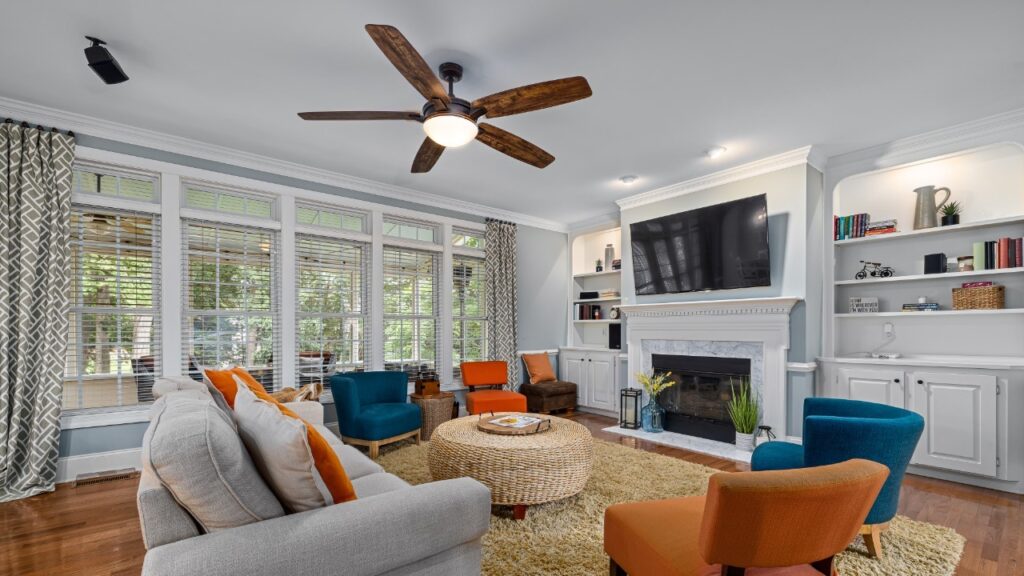
Some living rooms feel “busy” even when they aren’t actually that full. The good news is that crowdedness is often less about square footage and more about what your eyes and body perceive when you walk in. A few common layout and styling habits can make a perfectly workable space feel tight, hard to relax in, and tougher to keep tidy.
Below are six frequent culprits—and practical, family-friendly fixes that don’t require a full renovation.
1) Furniture that’s oversized (or just the wrong scale)
A roomy sectional can be wonderful for movie nights, but if it dominates the floor plan, it can shrink the entire room visually. Overscaled furniture tends to create “pinch points” where people have to squeeze by, and it can make normal daily movement feel like navigating an obstacle course. Even one too-large item can throw off the balance of everything around it.
What it looks like: The sofa back is nearly as tall as the window sill, the arms are thick and bulky, or the coffee table leaves only a narrow walkway. Chairs feel crammed into corners, and the room’s edges disappear behind furniture.
Why it feels crowded: Your brain reads the room by negative space (the open areas). When furniture eats up that negative space, the room feels smaller even if the square footage hasn’t changed.
Try this instead:
Measure your “circulation paths.” Make sure people can comfortably walk around the main seating area without turning sideways. If you have to sidestep around the coffee table or squeeze between the sofa and a wall, the scale is likely off.
Swap one big piece for two lighter ones. Instead of a heavy recliner plus a massive sectional, consider a standard sofa with two slimmer accent chairs. Two smaller items often feel airier than one bulky piece, even if the seating count is the same.
Look for legs and visual lift. Sofas and chairs raised on legs allow you to see more floor, which makes the room feel more open. A lower-profile sofa back can also help a space feel less blocked.
2) Pushing everything against the walls
It sounds logical: shove furniture to the edges and you’ll “free up” the center. But in many living rooms, wall-hugging actually makes the space feel like a ring of stuff surrounding a bare patch, which can read as cluttered at the perimeter and awkward in the middle. It can also emphasize the room’s tightness because you’re outlining every inch of its boundary.
What it looks like: Sofa flattened to the wall, chairs in opposite corners, side tables squeezed in wherever they fit, and a big empty strip down the middle that no one uses.
Why it feels crowded: The perimeter becomes a crowded “storage zone,” and the center feels like dead space rather than functional space. Your eye travels around the edges and gets stuck on too many objects.
Try this instead:
Float the sofa a few inches. Even 4–8 inches off the wall can help the room breathe. If you can, place a slim console table behind it for lamps or a basket—functional without looking jammed.
Create a clear conversation area. Pull chairs closer to the sofa to form a group. A defined seating zone reads as intentional rather than scattered.
Use a rug to “anchor” the layout. A properly sized rug lets you place at least the front legs of the sofa and chairs on it, visually connecting the pieces. That cohesion makes a room feel calmer and less cramped.
3) Too many small pieces (especially tables and extra seating)
Lots of little furniture can be more visually noisy than a few well-chosen larger pieces. Small items create many edges and gaps—each one a tiny “stop sign” for the eye. In family living rooms, this often happens gradually: an extra side table here, a spare ottoman there, a plant stand, a magazine rack, a little stool for kids. None of it seems like much on its own, but together it adds up.
What it looks like: Multiple side tables competing, mismatched occasional chairs, several small storage bins out in the open, and narrow pathways weaving between them.
Why it feels crowded: Visual fragmentation. The more separate objects your eye has to interpret, the busier the room feels.
Try this instead:
Consolidate surfaces. Replace two tiny side tables with one medium table, or choose a coffee table with a shelf or drawers so it can do more work with fewer pieces.
Choose “hybrid” pieces. An ottoman that also stores blankets, a storage bench that doubles as extra seating, or nesting tables that can tuck away when not needed are all family-friendly options that reduce clutter.
Edit the extras. If you have seating that’s rarely used, consider relocating it to another room. A living room that supports everyday life will feel better than one that’s arranged for occasional maximum capacity.
4) The wrong rug size (usually too small)
A rug is one of the fastest ways to make a living room feel more spacious—or more cramped. A rug that’s too small can make furniture look like it’s awkwardly “perching” around the edges, which visually breaks the room into pieces. It can also emphasize how much floor you’re trying to cover with furniture because nothing feels connected.
What it looks like: The coffee table sits on a tiny rug, while the sofa and chairs sit off it entirely. Or the rug is centered but doesn’t reach the front legs of any seating.
Why it feels crowded: A small rug makes everything look larger and more imposing by comparison, and it interrupts visual flow.
Try this instead:
Go bigger than you think. Aim for a rug that allows at least the front legs of the sofa and chairs to sit on it. This helps the seating area read as a single, intentional zone.
Use the rug to clarify pathways. When the seating group is visually unified, the remaining floor space around it reads as circulation space—making the room feel more functional and less jammed.
Choose a calmer pattern if the room is already busy. If you have lots of color or decor, a simpler rug can reduce visual clutter. If the room is plain, a subtle pattern can add interest without chaos.
5) Visual clutter: too many patterns, colors, and tiny decor items
A living room can be physically tidy and still feel crowded if every surface has something on it—or if there are too many competing patterns and colors. Families often collect meaningful items (photos, kids’ art, travel souvenirs), and those pieces can absolutely belong in the living room. The trick is to keep them from looking like they’re all “shouting” at once.
What it looks like: Throw pillows in five unrelated prints, a gallery wall that’s spread across multiple walls without a clear boundary, shelves packed edge-to-edge, and small objects on every table.
Why it feels crowded: Your eye has nowhere to rest. When every corner demands attention, the room feels busy and smaller.
Try this instead:
Limit your palette. You don’t need a monochrome room, but repeating a few key colors across pillows, art, and throws makes the space feel cohesive. Cohesion reads as calm, and calm reads as spacious.
Group small items. A tray on the coffee table can corral remotes, coasters, and a candle so it looks like one purposeful vignette instead of scattered objects.
Give decor breathing room. On shelves, try leaving some empty space around objects. On walls, consider concentrating art into one defined gallery area rather than sprinkling frames everywhere.
Rotate rather than display everything at once. If you love seasonal decor or have lots of sentimental pieces, store a portion and swap them out occasionally. The room stays fresh, and it won’t feel stuffed.
6) Poor lighting (and heavy window treatments) that flatten the room
Lighting can make a living room feel open and welcoming—or dim and compressed. When a space relies on a single overhead light, shadows collect in corners and the room can feel smaller. Heavy curtains or blocked windows also reduce natural light, which can make the entire space feel tighter and more enclosed.
What it looks like: One central ceiling fixture doing all the work, dark corners behind furniture, lamps that are too small to make an impact, or curtains that cover part of the window even when open.
Why it feels crowded: Darkness visually “shrinks” depth. When corners disappear into shadow, the room feels boxed in. Lighting also affects mood—dim, uneven light can make any mess feel more noticeable and stressful.
Try this instead:
Use layered lighting. Aim for a mix of ambient (overall), task (reading), and accent (highlighting) light. In practical terms: a floor lamp near the sofa, a table lamp on a side table, and possibly a small lamp on a console or shelf.
Choose lamp shades that spread light. Light-colored shades and bulbs that suit your preferred warmth help brighten the room more evenly. Even lighting makes the space feel larger and more comfortable.
Rethink window coverage. If privacy is a concern, consider lighter fabrics or shades that let in daylight while still providing coverage. Hanging curtains higher and wider than the window can also make the window feel larger and bring more light into the room when they’re open.
Add a mirror where it makes sense. A mirror placed to reflect a window or a bright area can help bounce light around. The goal isn’t to create glare—it’s to increase brightness and depth.
Putting it all together: a quick “less crowded” reset
If you want a simple way to make progress without getting overwhelmed, try this order:
First, clear the pathways. Walk through the room as if you’re carrying laundry, helping a child, or bringing snacks to the sofa. If you bump into things, remove or relocate the obstacles.
Second, unify the seating zone. Pull pieces into a conversation group and anchor them with a properly sized rug. This alone often changes the entire feel of the room.
Third, simplify the small stuff. Use trays, baskets, and closed storage to reduce the number of visible items. Then edit decor so it looks intentional instead of everywhere.
Finally, brighten and soften. Add a lamp, open the curtains, and make sure corners aren’t left in shadow. A brighter room almost always feels bigger.
A living room that feels open isn’t about having nothing—it’s about having the right things in the right scale, with enough space to move, breathe, and actually enjoy family life. Small changes can make the room feel calmer quickly, and the best part is you’ll notice the difference every day.