
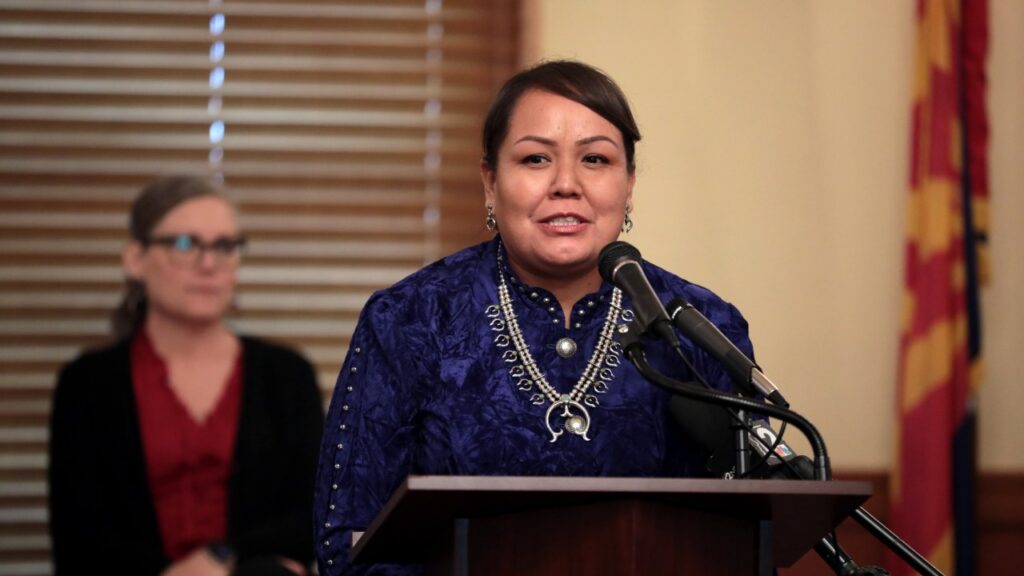
A third-grade field trip to the Navajo Nation Council chamber is where this story actually starts. Crystalyne Curley watched two tribal lawmakers get into a fiery debate that day, and something clicked. On Election Day this week, she became the first woman ever elected president of the Navajo Nation — the largest tribe in the country by land.
What happened
Curley, who narrowly defeated attorney Justin Jones according to unofficial results, will take office in January alongside running mate Chris Deschene, according to reporting from the Associated Press, republished by ITV News. KRQE News 13 put a number on just how narrow it was: unofficial results had Curley and Deschene ahead by roughly 1,000 votes out of more than 63,000 cast across the Navajo Nation’s 110 chapters. She was already a history-maker once before this: Curley was the first woman to lead the Navajo Nation Council as its speaker. “I thought to myself at a very young age, that’s where I want to be,” she told the AP, describing that childhood field trip.
The Navajo Nation’s modern, centralized government has been led by men since it was established under federal pressure more than a century ago. Curley’s win changes that, and she knows exactly what it means. “This is a win for all Navajo women,” she said.
What she says it took to get there
Curley told the AP she faced sexist rhetoric while campaigning, and she expects to be held to a higher standard now, simply for being the first. “As women, we have to work twice or triple as hard, especially within Navajo politics,” she said. A Navajo voter named Lene Bitsui, who backed Curley hoping she could restore order after what Bitsui called a period of dysfunction in the tribal government, admitted she almost didn’t believe a woman could win. “I thought our people weren’t ready for a female president,” Bitsui told the AP. “I was wrong, and I feel so happy to have been wrong.”
Not the only “first” this week
Curley’s win landed in the middle of a broader shift. Peggy Flanagan became the first Native American woman elected to the U.S. Senate this week, and Deb Haaland — the first Native American to ever lead a U.S. Cabinet agency — became the first female Native governor of a U.S. state, winning in her home state of New Mexico. More than 230 years after the Senate was established, only four Native people have ever served in it, and all were men until Flanagan. The Seneca Nation of Indians, in western New York, also elected its first woman president this week: longtime council member Tina Abrams.
Jordan James Harvill, a Cherokee Nation citizen and strategist with the advocacy group Advance Native Political Leadership, called it exactly what it looks like. “This is a seismic shift that is happening in our communities,” he told the AP.
The tradition argument cuts both ways
Not everyone in the Navajo Nation agreed this was overdue. Some Navajo people believe traditional teachings prohibit women from holding the top government position, while others point out that stance never squared with the matrilineal structure of Diné society in the first place. Jennifer Nez Denetdale, a professor of Diné studies at the University of New Mexico, put it plainly to the AP: “You see the language of tradition used to both deride the possibility of a woman being president and to say that women’s leadership is needed now.”
What changes in January
Once Curley and Deschene are sworn in, they plan to move the Navajo Nation away from coal development — historically one of the tribe’s major economic engines — and push the tribe back into a leading role in national conversations about federal Indian policy. That’s a real governing agenda, not just a historic headline, and it’s worth watching whether it holds up once the ceremony is over and the work starts.
You don’t have to be Navajo, or from the Southwest, or especially plugged into tribal politics to feel the shape of this week. A third-grader who watched two men argue in a council chamber grew up to run that government herself, and she’s not the only woman who got there this week. That part travels well past the reservation’s 27,000 square miles.