
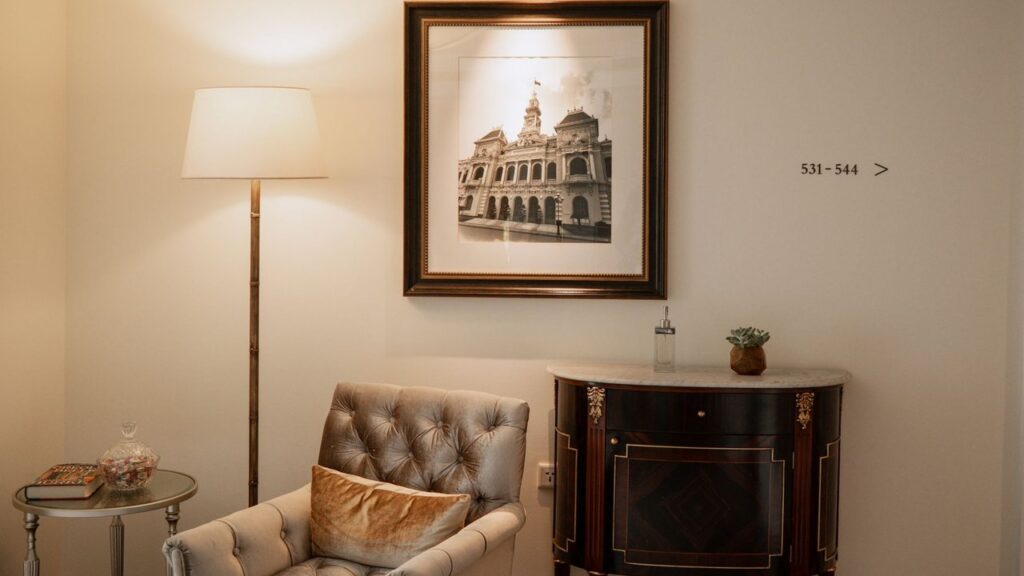
A living room can have four lamps glowing and still feel like a cave, and the reason usually has nothing to do with how many bulbs are burning. It comes down to where the light actually falls. Most lamps sit at the same low height, throw light in the same small radius, and leave the corners, ceiling plane, and walls almost untouched — so the eye reads the room as dim even though there is plenty of wattage in it. Fixing that is less about buying more lamps and more about rethinking where the light goes.
Why several lamps can still leave a room feeling flat
Table lamps and floor lamps typically sit around the same height, somewhere between knee and shoulder level, which means their light pools in roughly the same horizontal band. You end up with several bright circles on side tables and an unlit gap everywhere in between, including the walls and ceiling. A room reads as bright when light hits multiple planes — not just the surfaces lamps happen to sit on, but the walls, the ceiling, and the space above furniture. Four lamps clustered at the same height can light the furniture perfectly while leaving the architecture of the room in shadow, which is often what people mean when they say a space feels dark despite the fixtures.
The vertical light most rooms are missing
A living room with no light source above eye level tends to feel low-ceilinged and closed in, even with strong lamps. Uplighting — a torchiere lamp, a wall sconce, a picture light angled upward — bounces light off the ceiling and upper walls, which brightens the whole room by reflection rather than by direct glare. This is one of the simplest changes to make without rewiring anything: replacing one table lamp with a floor lamp that has an open or upward-facing shade, or adding a single sconce near a dark corner, changes how much of the vertical space participates in the lighting instead of leaving it to shadow.
When warm and cool bulbs are working against each other
Mismatched color temperature is a quieter culprit. Bulbs are rated on the Kelvin scale, and a room mixing a warm 2700K bulb in one lamp with a cooler 4000K bulb in another can look dingy and uneven even though both bulbs individually put out reasonable light. The eye perceives the inconsistency as murkiness rather than as two different shades of white. Standardizing bulbs across a room — picking one color temperature, usually a soft warm white for a living room — tends to make the space look brighter and more cohesive than adding another lamp with yet another mismatched bulb.
What walls, floors, and fabric are doing to your light
Light placement interacts with what it is bouncing off. Dark paint, heavy curtains, matte dark wood floors, and dark upholstery all absorb light rather than reflecting it, so a room with those finishes will swallow lamp output that a lighter room would bounce back and amplify. This does not mean a dark palette is a mistake — plenty of rooms are deliberately moody — but it does mean that achieving a genuinely bright feel in a dark-toned room usually requires more deliberate light placement, including uplighting and layered sources, than the same wattage would need in a room with pale walls and glossy or light flooring. If a room feels dark despite several lamps, it is worth noticing whether the surfaces around those lamps are working with the light or absorbing it.
The three layers a well-lit room actually needs
Designers commonly talk about lighting in three layers: ambient light that fills the room generally, task light aimed at a specific activity like reading, and accent light that highlights a feature such as art or a bookshelf. A room with four lamps but only one layer — four sources all doing the same job of casting a pool onto a side table — is missing the ambient fill and the accent highlights that make a space feel complete. Swapping one or two lamps for roles they are not currently filling, rather than adding a fifth identical lamp, usually does more for the overall brightness and depth of the room.
A practical way to see where your light is actually going
Turn on every lamp in the room at night, then walk the perimeter and notice which walls, corners, and ceiling areas stay dark. Those gaps are the places that need a vertical or upward-facing source, not another table lamp duplicating what is already there. Check whether the bulbs match in color temperature, and consider whether the darkest surfaces in the room — a navy sofa, a walnut floor, charcoal curtains — are quietly absorbing light that a paler surface nearby would reflect back into the space. The goal is not more lamps but better-distributed light: something at eye level for tasks, something above eye level to brighten the ceiling plane, and consistent bulb color throughout, so the room reads as evenly lit rather than dotted with bright spots surrounded by shadow.
Image Credit: Faheem Ahamad — Pexels License / Pexels