
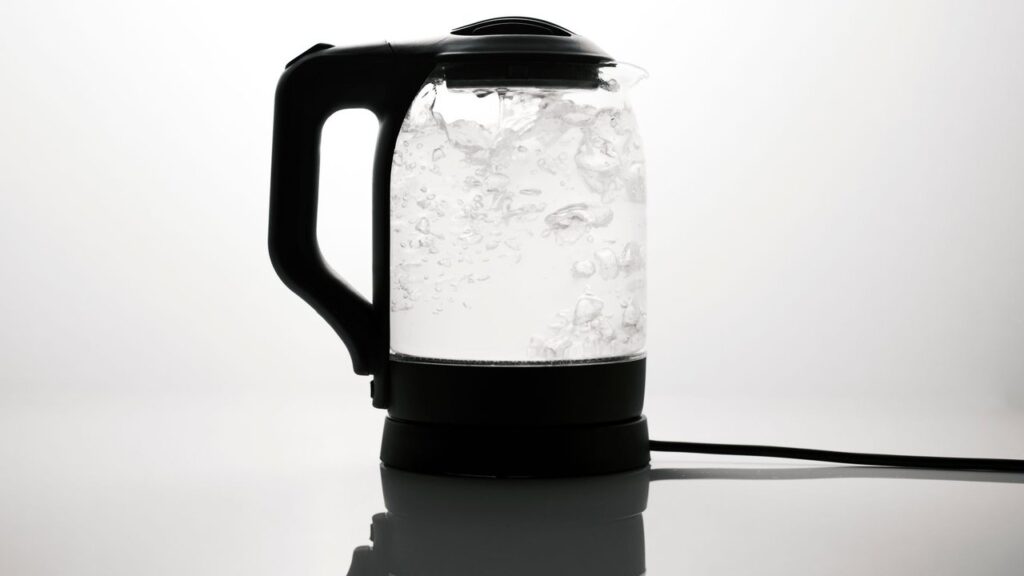
If your kettle seems to take forever to reach a boil lately, the culprit probably isn’t your power outlet or an aging cord. It’s almost certainly limescale — the chalky mineral coating that builds up on a heating element every time hard water is boiled and left to evaporate or cool. That crust acts like a blanket between the element and the water, forcing the kettle to work harder and longer to transfer the same amount of heat.
How tap water turns into a crusty coating.
Most tap water carries dissolved minerals, mainly calcium and magnesium, picked up as it travels through soil and pipes. Water with a lot of these minerals is usually called hard water, and the amount varies a great deal depending on where you live and what your local supply draws from. When you heat that water, the minerals become less soluble and start separating out of the liquid, clinging to whatever hot surface they touch first — in a kettle, that means the heating element and the inner walls near it. Each boil leaves behind a microscopic layer. On its own, one layer is nothing. After weeks or months of daily use, those layers stack into a visible, sometimes gritty, white or grayish crust.
What that buildup is doing to the heating element itself.
Metal conducts heat efficiently; mineral scale does not. Once scale coats the element, the kettle has to generate more heat just to push the same warmth through to the water, because a layer of insulation is now sitting in the way. That is the direct, mechanical reason boiling slows down — it isn’t that the kettle has gotten weaker, it’s that the heat has to travel through an extra obstacle before it ever reaches the water. Over time, a heavily scaled element can also run hotter than it’s designed to in order to compensate, which may shorten the working life of the heating mechanism and, in some models, trip an automatic shutoff earlier than expected. The exact lifespan impact depends on the kettle’s design and how hard your water is, so treat this as a general mechanical pattern rather than a guaranteed timeline for any specific appliance.
The clues that your kettle is already coated.
A longer wait for the water to roll into a boil is usually the first sign, but there are others worth checking. Look for white or chalky flecks floating in the water or settled at the bottom of the kettle. Water that looks slightly cloudy right after boiling, even though it clears as it cools, often points to dissolved minerals rather than anything wrong with the water itself. Some people also notice a change in the sound of the boil — a louder popping or crackling as steam pushes through pockets of scale — or a faint flat, mineral taste in tea or coffee made with that water. None of these signs are dangerous; they’re simply evidence that the kettle needs attention.
Descaling at home without specialty products.
You don’t need a commercial descaling solution to clear ordinary limescale. A simple approach many households use is filling the kettle with equal parts water and plain white vinegar, letting it sit for roughly half an hour to an hour, then bringing it to a boil and letting it cool before emptying and rinsing thoroughly several times. Citric acid, dissolved in water per the package’s suggested ratio, works through a similar principle and tends to leave less odor behind. Whichever method you use, rinse the kettle multiple times afterward and boil a batch of plain water that you discard before using it for drinks again, so no residual taste carries over. How often this is needed depends heavily on your local water hardness — homes with very hard water may want to descale monthly, while those with naturally softer supplies might go several months between treatments. If you’re unsure how hard your water is, a visible buildup after just a few weeks is itself a reasonable signal to start a regular routine.
Softer habits that slow the buildup going forward.
You can’t change what’s dissolved in your tap water, but a few routine adjustments reduce how fast scale accumulates. Emptying the kettle after each use rather than letting boiled water sit and evaporate inside it cuts down on mineral residue left clinging to the surface. Wiping the interior dry occasionally, once it’s cooled, keeps moisture from sitting against the element between uses. Using filtered water for the kettle, if that’s practical for your household, reduces the mineral load going in to begin with. None of these steps eliminate limescale entirely — as long as you’re boiling ordinary tap water, some buildup is inevitable — but they can meaningfully stretch the time between descaling sessions.
The next time your kettle seems sluggish, skip the assumption that it’s dying and reach for vinegar or citric acid first. A ten-minute descale, repeated on a schedule that fits your water, is usually all it takes to restore both the speed and the quiet hum of a kettle working the way it was built to.
Image Credit: Engin Akyurt — Pexels License / Pexels