
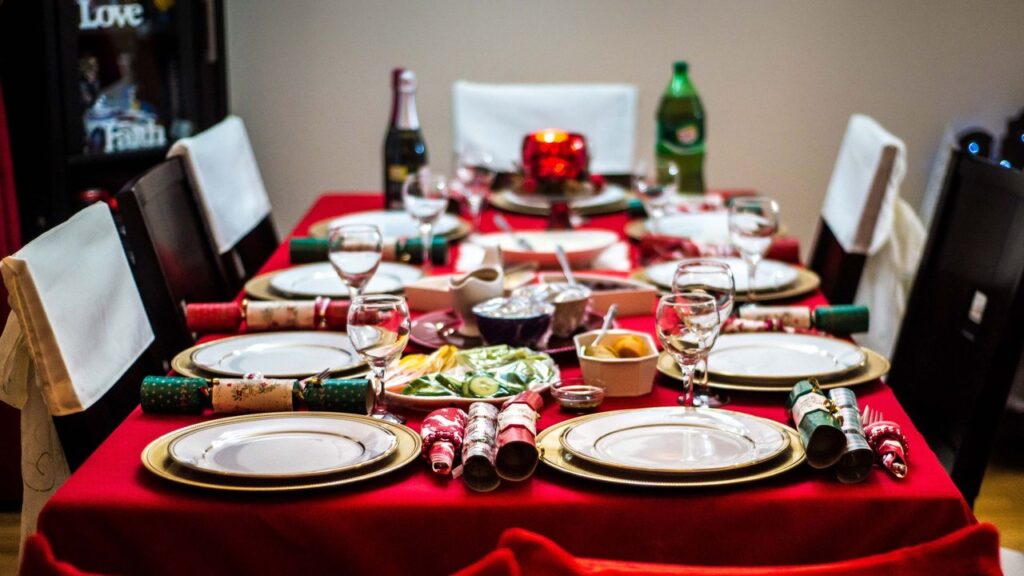
If your holiday table sits twelve people but still feels like everyone’s bumping elbows, the problem probably isn’t your chair count — it’s the math underneath it. Event designer Sofia Crokos, who plans large dinners for a living, told The New York Times she builds every seating plan around a minimum of two feet, or 24 inches, of table edge per guest, because that’s roughly what someone needs to cut, pass, reach and gesture without colliding with the people on either side. Once you know that number, you can measure your own table and find out whether the crowding you feel every year is actually a spacing problem you can fix. Thanksgiving Table Setting Ideas for a Big Crowd – The New York Times
The Two-Foot Guideline Event Designers Use
The Two-Foot Guideline Event Designers Use
Crokos’s rule isn’t about formality — it’s about what your arms actually need to do during a meal. “There’s a lot of hand and arm motion going on,” she told The Times, explaining why even a cozy, elbow-to-elbow table still needs room for cutlery, glassware and the occasional gravy boat hand-off. To use this as a planning tool, measure the usable perimeter of your table — the long sides where people actually sit, not the narrow ends unless chairs go there too — then divide by 24. If your table is 96 inches long on each long side, that’s eight place settings along the two sides before you even count the ends. If you’ve been wedging ten chairs into that same length, the discomfort your guests feel isn’t imagined; it’s a few inches of missing elbow room per person. Thanksgiving Table Setting Ideas for a Big Crowd – The New York Times
Why a 42-Inch-Wide Table Feels Different Than a 32-Inch One
Width matters just as much as length, according to Brooklyn interior designer Catherine Brophy, who told The Times that a standard dining table runs 42 to 48 inches wide, while tables built for tight apartments are often closer to 32 to 36 inches. A narrower table doesn’t just save floor space — it also shortens the reach across the table for shared dishes, which can make a long, skinny arrangement feel more sociable than a wide one, even with the same number of place settings. If you’re choosing between a wider table that seats fewer people comfortably or a longer, narrower one that fits more, the narrower option often wins for holiday gatherings precisely because reaching for the stuffing shouldn’t require standing up. Thanksgiving Table Setting Ideas for a Big Crowd – The New York Times
Chair Height and the Twelve-Inch Gap That Decides Comfort
Spacing along the table is only half the equation; the vertical fit matters too. Bob Vila’s holiday seating guide notes that most dining tables stand 29 to 32 inches tall, and that people are generally comfortable in chairs around 18 inches tall, which leaves about 12 inches of clearance between the seat and the tabletop. Borrow taller stools from the kitchen island or mismatched chairs from another room, and that gap can shrink or grow enough to put knees into the underside of the table or leave guests reaching upward to eat. Round pedestal tables, which rely on a single center leg instead of four corner legs, tend to offer more usable legroom per seat, which is worth knowing if you’re deciding between two similarly sized tables for the big day. 13 Tips for Fitting Everyone Around the Thanksgiving Table – Bob Vila
When the Spacing Math Says Add a Leaf, a Bench or a Second Table
Once you’ve measured your table against the two-foot rule, the fix usually falls into one of three categories. New York designer Vicente Wolf told The Times he often pushes two identical tables together for everyday use and pulls them apart when a crowd is coming, instantly doubling capacity because each side can now seat people. Chicago designer Alexandra Kaehler has arranged her own dining table plus two folding tables into an “I” shape to seat 22, unifying the look with matching linens so the extra tables don’t read as an afterthought. A bench along one side is another option designers favor, since it holds more people shoulder-to-shoulder than individual chairs without needing room to pull chairs out. Picture a family expecting ten guests at a table that comfortably fits eight by the two-foot measurement: rather than squeezing two extra chairs into the existing footprint, swapping one side for a bench, or wheeling in a drop-leaf table that normally serves as a side table, adds real inches instead of just adding bodies. Thanksgiving Table Setting Ideas for a Big Crowd – The New York Times
Clearing the Center So Your Measurement Isn’t Undone by Decor
A table that technically has 24 inches per person can still feel cramped if serving dishes, a tall centerpiece and a water pitcher are eating into that space. Bob Vila’s guide suggests moving serving dishes to a buffet, kitchen island or countertop so guests return for seconds rather than reaching across a crowded table, and keeping centerpiece decor minimal when space is tight. The Times similarly reported that designer Sofia Crokos spreads decorations into several small arrangements down the table’s length instead of one large centerpiece, so no single cluster steals space from the plates around it. If your table passes the two-foot test on paper but still feels tight in practice, the serving dishes and decorations in the middle are often the real culprits, not the chair count. 13 Tips for Fitting Everyone Around the Thanksgiving Table – Bob Vila
Before you rearrange furniture or buy a leaf you don’t need, grab a tape measure. Walk the length of your table, divide by 24, and compare that number to how many chairs you’re currently planning to fit. If the math comes up short, you now have a specific decision to make — push two tables apart, swap in a bench, borrow a drop-leaf table, or simply move the serving dishes off the table entirely — instead of just hoping everyone squeezes in comfortably.
Image Credit: Dax — Pexels License / Pexels