
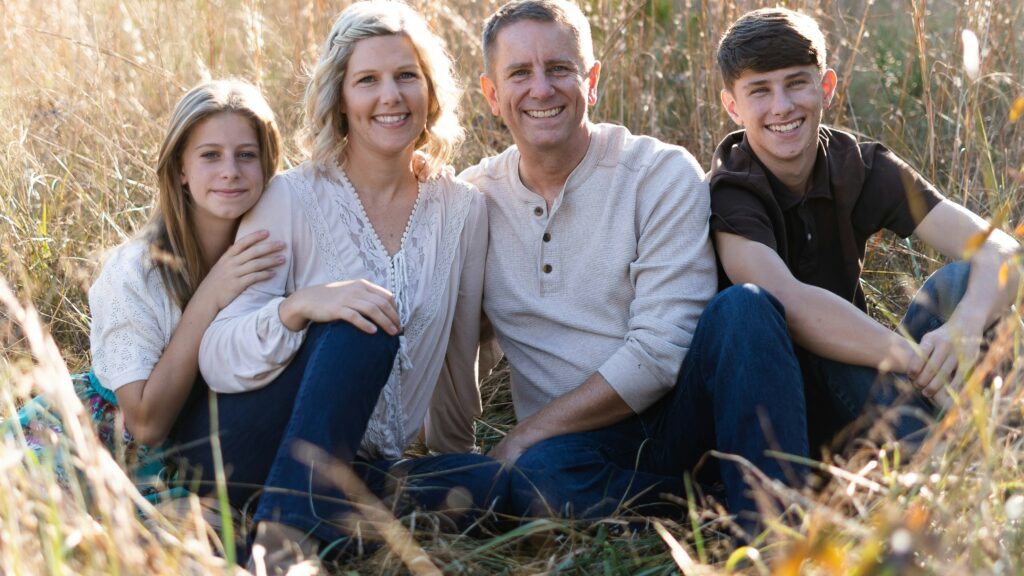
There’s a certain kind of pressure that shows up every fall: the “perfect” family photo. Suddenly, it feels like you’re supposed to coordinate everyone’s outfits, scout a picturesque field, and hope your kids smile on command while the light hits just right.
But the photos you’ll actually love in five, ten, twenty years usually aren’t the ones where everyone looks like they stepped out of a catalog. They’re the ones that feel like you—your real rhythms, your real relationships, your real season of life. The good news: you can absolutely get beautiful fall family photos without matching outfits or manufacturing a mood.
Here are five practical ways to capture family pictures that look polished enough to frame, but honest enough to feel like home.
1) Build a “color story,” not matching outfits
Matching outfits can look cute, but they can also make people feel stiff—especially if someone hates the sweater you chose or the kids are itchy and cranky before you even start. A “color story” is an easier, more realistic approach: pick a loose palette and let everyone dress like themselves inside it.
Start with two neutrals and one accent color. Neutrals like cream, denim, olive, camel, navy, charcoal, or soft gray photograph well and won’t fight with fall backgrounds. Then add a single accent—rust, mustard, burgundy, forest green, or dusty blue—depending on what you already own and what you actually like wearing.
Use coordination rules that are easy to remember. For example:
• Everyone wears one neutral (denim counts).
• Only one person wears a bold pattern, everyone else stays solid or subtle.
• No more than two people in the same exact color top.
Prioritize comfort over “photo worthy.” If a child can’t sit, run, or be hugged in it, it won’t photograph well. If you can’t breathe or move naturally, it will show. Comfortable clothes create relaxed faces and real body language—those are the photos that look alive.
Lean into texture instead of matchy-matchy. Fall is basically a texture season: knits, denim, corduroy, suede, fleece, flannel, wool coats, boots. Mixing textures creates visual interest even when everyone’s wearing simple colors. It also makes your photos feel warm and dimensional.
Consider location, but don’t let it dictate everything. If you’re shooting in a place with heavy red/orange leaves, avoid dressing everyone in the same saturated warm tones head to toe, or people can blend into the background. Balance warm with cool (navy, denim, forest green) or add cream/neutral layers to keep faces the focus.
Most importantly: let everyone look like themselves. A favorite jacket, a well-worn pair of boots, your partner’s everyday flannel—those pieces tell the truth of your family far better than a coordinated outfit set you’ll never wear again.
2) Choose an activity, not a pose
If your goal is “everyone stand here and smile,” you’re setting yourself up for the same three photos: one where someone blinks, one where someone’s mad, and one where everyone looks like they’re waiting for instructions.
Instead, give your family something to do. Activities create natural closeness, real expressions, and little moments you can’t force. You’ll still get a few classic “look at the camera” frames, but the heart of your gallery will feel like your actual life.
Pick an activity you already do in fall. A few ideas that photograph beautifully without feeling staged:
• Walking a familiar loop around your neighborhood or a local park
• Pumpkin patch browsing (not just holding pumpkins—let the kids explore)
• Apple picking, carrying bags, tasting, wiping sticky hands
• Throwing leaves, raking, and making a pile to jump into
• Hot cocoa on the porch steps or in the car after a chilly walk
• Baking something simple (cookies, muffins, apple crisp) and photographing the in-between moments
Give prompts that spark interaction. If you’re taking the photos yourself or asking a friend to help, prompts work better than poses. Try:
• “Everyone walk toward me, bump shoulders, and talk to each other.”
• “Pick up the youngest and spin once—slowly.”
• “Tell Mom/Dad your favorite thing that happened this week.”
• “Kids, try to make your grown-ups laugh.”
• “Hold hands like you’re crossing a street.”
Let movement do the work. Movement helps people stop thinking about their faces. It also creates variety: hands swinging, hair shifting, coats flaring, kids hopping over sticks. If someone gets silly, that’s not a mistake—that’s personality.
Plan for short bursts. If you have little kids, aim for 15–25 minutes of actual shooting time. You can always extend if things are going well, but it’s easier to end on a win than push until everyone melts down.
When you choose an activity, your photos won’t just show what everyone looks like. They’ll show how it feels to be in your family.
3) Use light and timing that work with real schedules
Photographers love “golden hour” for a reason: it’s soft, flattering, and warm. But families also live in the real world of naps, homework, early bedtimes, and sports practice. You can still get great fall light without forcing a perfect schedule.
Know your light options (and use the easiest one).
• Golden hour: The hour before sunset. Beautiful, but can be chaotic if it overlaps with dinner or bedtime.
• Open shade: Shade near a bright area—like under a tree line, next to a building, or on a covered porch. This is the secret weapon for family photos because it’s consistent and forgiving.
• Overcast days: Cloud cover acts like a giant softbox. Colors look rich, and you don’t have to fight harsh shadows.
Avoid midday sun when possible. If you must shoot in the middle of the day (hello, packed fall weekends), find open shade. Direct overhead sun creates squinting, deep eye shadows, and shiny foreheads—none of which are “you” problems; they’re just lighting problems.
Choose a time when your kids are most like themselves. For some families, that’s right after breakfast. For others, it’s after a snack and some outdoor time. The best light is the light you can actually show up for without everyone being miserable.
Keep faces turned toward the light, not into it. If you’re in open shade, position your group so they’re facing the brighter area (like the open sky), not the darker background. You’ll get bright eyes and even skin tones without asking anyone to “stand still and smile.”
Don’t be afraid of the “imperfect” backdrop. A quiet sidewalk with trees, your front steps, the edge of a playground, a backyard fence with climbing vines—these can all look gorgeous with good light and real connection. A meaningful location often ages better than a trendy one.
Lighting doesn’t have to be complicated. If you can find soft light and a time when your family is regulated enough to be playful, you’re already most of the way there.
4) Make candid photos easier by planning tiny details
Candid photos aren’t an accident—they’re usually the result of small choices that make people comfortable and keep the flow moving. A little preparation keeps the session from turning into a negotiation.
Do a “pocket check” and a comfort check. Five minutes before you start:
• Wipe faces and noses (especially in chilly weather)
• Remove phones, keys, hair ties, receipts from pockets
• Check for distracting items on wrists (random bands) or around necks (lanyards)
• Make sure shoes and socks are comfortable for walking
None of this is about perfection; it’s about reducing little distractions that pull you out of the moment.
Bring one simple “reset” tool. Choose one of these and keep it in your bag:
• A neutral blanket for sitting shots (also great for snuggling)
• Wet wipes for hands and faces
• A small snack that won’t stain (think crackers, pretzels, or apple slices)
• A warm drink in a travel cup for after (a built-in reward and a cozy photo moment)
Use layers strategically. Layers aren’t just cute; they’re practical. A jacket, vest, scarf, or beanie gives people something to do with their hands and keeps kids warmer so they’re not distracted. Layers also let you create variety quickly—take a few shots with coats on, then a few with coats off if the weather allows.
Let kids be kids, but set one boundary. Candid doesn’t mean chaos. One clear expectation helps: “We’re going to play and move, but you need to stay close to us.” That’s it. You don’t need a dozen rules. You’re aiming for safe and connected, not silent and still.
Capture transitions. Some of the sweetest photos happen between “official” moments: walking to the spot, fixing a collar, tying a shoe, holding hands on a path, lifting a child over a puddle. If you’re photographing your own family, set your phone or camera to take bursts or a short video you can pull frames from later. If someone else is photographing you, tell them you want the in-between moments, not just the posed ones.
Planning tiny details doesn’t make your photos feel staged. It makes it easier for real life to unfold in a way you can actually capture.
5) Tell the truth of your family—then take one classic frame
It’s tempting to chase an aesthetic. But the most meaningful photos are often the ones that reflect what’s true right now: who your kids are, what your home feels like, the way your partner looks at your toddler, the way your oldest pretends they’re too cool but still leans in close.
Decide what you want to remember. Before the camera comes out, think about what you’d be sad to forget:
• The missing front tooth grin
• The way your baby curls into your neck
• The hand-holding phase (it doesn’t last forever)
• The sibling dynamic—sweet one second, wild the next
• The rituals: Saturday morning walk, porch sitting, leaf pile in the yard
When you know what matters, you’ll stop worrying about whether everyone’s outfit matches and start watching for the moments that actually define this season.
Photograph the relationships, not just the lineup. Aim for a mix like this:
• Everyone together (walking, hugging, sitting close)
• Each parent with each child (or each caregiver, depending on your family)
• Sibling shots (give them something to do: “hold hands and race to that tree”)
• A few individual portraits (especially if a child is going through a big change)
Embrace the “imperfect” expressions. A serious face isn’t a failure. A kid looking away isn’t a ruined photo. Sometimes the most honest pictures are the quiet ones: a thoughtful look, a shy half-smile, a child watching leaves fall. Variety makes your gallery feel real.
Then, yes: take one classic frame for the grandparents (and future you). You can have it both ways. After you’ve captured movement and connection, take two minutes for a simple, straightforward shot where everyone looks at the camera. Keep it quick:
• Put everyone close—shoulders touching.
• Have the tallest people in the middle or back.
• Ask for a “soft smile,” not a forced grin.
• Take several shots in a row to catch open eyes.
That classic frame is useful, but it doesn’t have to be the whole story.
Fall family photos don’t need to prove anything. They don’t need to show a version of your family that only exists on picture day. If you choose comfortable clothes, plan an activity, find forgiving light, and focus on connection, your photos will feel like your real life—just lovingly documented.
And years from now, that’s exactly what you’ll want to remember.